
The Songwriter’s Map: How to Build Powerful Chords From The Major Scale
Alright, you’ve done the grind. Hours of practice at 60 BPM until your fingers could play them in your sleep. Your fingers know every note on the fretboard inside and out. That’s great. But let’s be real for a second, nobody’s throwing their fists in the air because you played a scale “notes” cleanly.
To actually move people to make them feel something great, you need to understand how those seven notes stack together to create chords for a song.
I remember when I first watched my teacher instantly guess the chords to songs he’d never heard before. I thought he had some kind of supernatural gift. Some kind of musical wizardry. But it wasn’t. He simply knew the formula that transforms a scale into chord progressions. And today, I’m going to hand you that same formula so you can stop seeing the guitar as just a bunch of frets, wood, and strings, and start seeing it as a song-generating machine.
Here’s where things get really interesting. If the individual notes of a scale are like letters, then chords are the words you build from them. When you listen to a guitarist and feel that huge, powerful, emotional wall of sound hitting you, they’re not randomly throwing notes together. They are using the Diatonic chord scale.
When I was starting out, I thought chords were just memorized shapes from a diagram like you had to learn each one separately with no connection. Then my teacher showed me that every single chord is actually hidden inside the scale itself. That moment my mind was completely blown. It’s like finding a secret code that was there the whole time.
How to Build a Major Chord: The Formula
To build a basic chord what musicians call a Triad. You don’t need all seven notes from the scale. You only need three notes.
Look at our map of the C Major scale:
C – D – E – F – G – A – B – C
Let me show you how is works with the C Major chord:
- Start with the 1st (C) the rote note
- Skip the 2nd note (D) and take the 3rd note (E)
- Skip the 4th note (F) and take the 5th note (G)
Put them together C – E – G and you’ve built a C Major chord. The beautiful part? This same pattern builds all major chords. Once you master this pattern, you’ve unlocked Major chord construction.
- Note: C- E – G
- Formula: 1st – 3rd – 5th
Let’s Build The 7 Chord Formula Sheet: C Major Scale
| Degree | Chord | Notes | Chord Quality | Roman Numeral |
| 1st | C | C – E – G | Major | I |
| 2nd | Dm | D – F – A | Minor | ii |
| 3rd | Em | E – G – B | Minor | iii |
| 4th | F | F – A – C | Major | IV |
| 5th | G | G – B – D | Major | V |
| 6th | Am | A – C – E | Minor | vi |
| 7th | Bdim | B – D – F | Diminished | Vii |
How They Sound: Major Scale Chords
| Degree | Chords | Sound This Way |
| 1st | Major | Home Base, Stable, Happy |
| 2nd | Minor | Softer, Transitional Minor, Moody |
| 3rd | Minor | Emotional Minor Color, Soft |
| 4th | Major | Strong Uplifting Major |
| 5th | Major | Wants To Resolve, Bright |
| 6th | Minor | Sad But Stable Minor, Deep Emotional |
| 7th | Diminished | Tense, Unstable |
The Foundation Of C Major Key Chords Progression to Play:
In the key of C Major, these three chords are the engine that is used in almost every famous song. If you can master the movement between these three chords, you can play thousands of songs today.
1. I the home C Major
2. IV the journey F Major
3. V the tension G Major
| Key | I (Home) | IV (Journey) | V (Tension) |
| C Major | C | F | G |
Why Do These Three Chords Work So Well Together?
Think of it like a story. The 1st (I) chord is home. Everything feels safe and complete there. The 2nd (IV) chord is the beginning of the journey, movement. Then comes the 3rd (V) chord . This is where tension builds. It introduces instability that naturally wants to resolve. WHen you play a G Major 3rd (V) chord Your ears instinctively want to return to the 1st C Major (I) chord. That emotional pull is what makes this progression timeless.
More Theoretical but Cinematic:
Now we’re into serious powerful territory. I, IV and V build the foundation. But when you add the VI chord A Minor, you introduce feelings and soul.
1. I – the home: C Major
2. VI – the soul: A Minor
3. IV – the journey: F Major
4. V – the tension: G Major
| Key | I (Home) | VI (The Soul) | IV (Journey) | V (Tension) |
| C Major | C | Aminor | F | G |
Building the F Major Chord: Step By Step
You’ve already cracked the code in C Major, Let’s take that same blueprint and move it to F major.
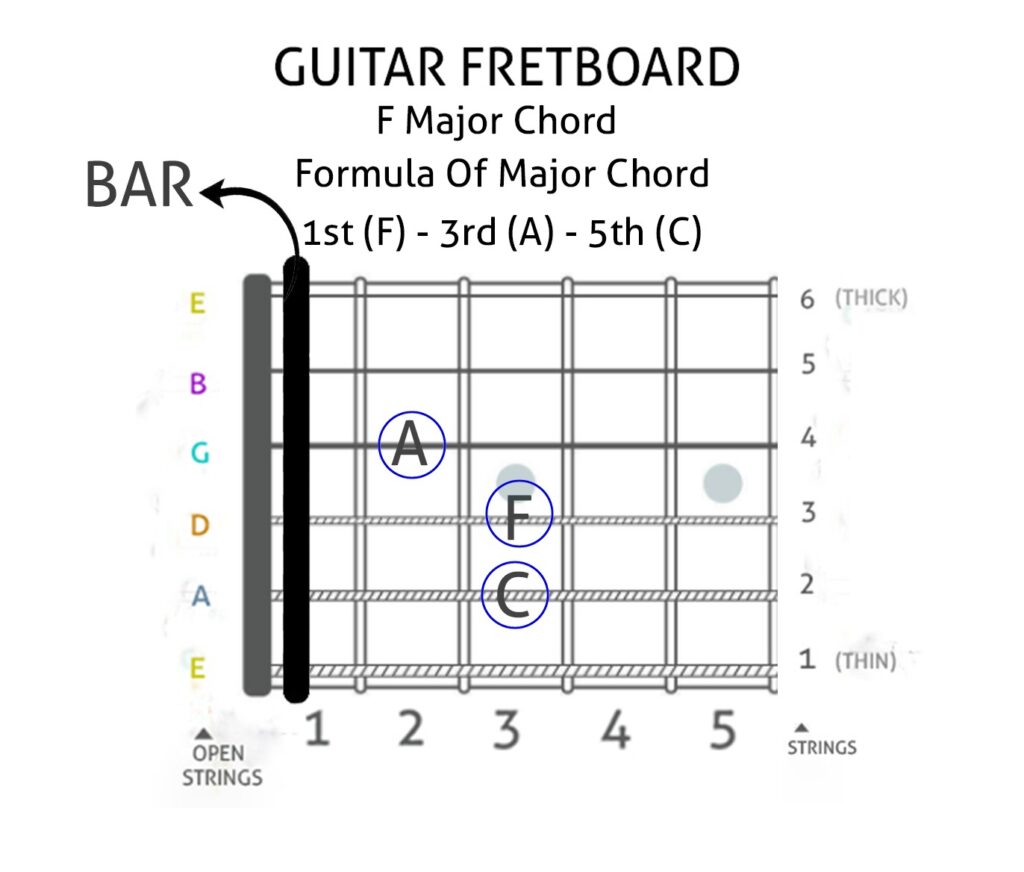
The formula stays the same 1- 3 – 5. That’s universal. But F Major has one small difference. F Major includes a B♭. Even if we skip over it when building the root chord, knowing exactly where that C lives in the scale is what separates beginners from players who truly understand what they’re doing.
Look at our map of the F Major Scale:
F – G – A – B♭ – C – D – E – F
Let me show you how is works with the F Major chord:
- Start with the 1st (F) the rote note
- Skip the 2nd note (G) and take the 3rd note (A)
- Skip the 4th note (B♭) and take the 5th note (C)
Put them all together F – A – C and you’ve built an F Major Chord.
- Note: F – A – C
- Formula: 1st – 3rd – 5th
| Chord Component | Scale Degree | Note |
| Root | 1st note | F |
| Major 3rd | 3rd note | A |
| Perfect 5th | 5th note | C |
Let’s Build The 7 Chord Formula Sheet: F Major Scale
| Degree | Chord | Notes | Chord Quality | Roman Numeral |
| 1st | F | F – A – C | Major | I |
| 2nd | Gm | G – B♭ – D | Minor | ii |
| 3rd | Am | A – C – E | Minor | iii |
| 4th | B♭ | B♭ – D – F | Major | IV |
| 5th | C | C – E – G | Major | V |
| 6th | Dm | D – F – A | Minor | vi |
| 7th | Edim | E – G – B♭ | Diminished | Vii |
How They Sound: Here’s The Breakthrough
All Major keys follow the exact same internal pattern like the same harmonic DNA. Notes change but pattern does not. It doesn’t matter whether you’re in C Major, F Major, or playing any other key. Change the key, change the notes but the emotional behavior and sound stays the same. That’s the power of the Major mode system.
The Foundation Of F Major Key Chords Progression to Play:
In the key of Major, the harmonic engine runs on the three chords from the backbone of countless songs. They create the sense of home, departure, and return that defines so much of western music.
1. I – the home: F Major
2. IV – the journey: B♭ Major
3. V – the tension: C Major
| Key | I (Home) | IV (Journey) | V (Tension) |
| F Major | F | B♭ | C |
Expanding The Harmonic Power of F Major:
Now add VI D minor chord, the VI D minor chord acts as a tonic substitute. Emotionally , it introduces warmth, vulnerability, and depth.
1. I – the home: F Major
2. VI – the soul: D Minor
3. IV – the journey: B♭ Major
4. V – the tension: C Major
| Key | I (Home) | VI (The Soul) | IV (Journey) | V (Tension) |
| F Major | F | D minor | B♭ | C |
Building the G Major Chord: Step By Step
You’ve already cracked the code in F Major key. Now let’s transfer it to G Major. The formula remains the same 1 – 3 – 5. That never changes. However, G Major has one important difference, it includes F# note, its Major 7th.
Here Is The G Major Scale:
G- A – B – C – D – E – F# – G
Let me show you how is works with the G Major chord:
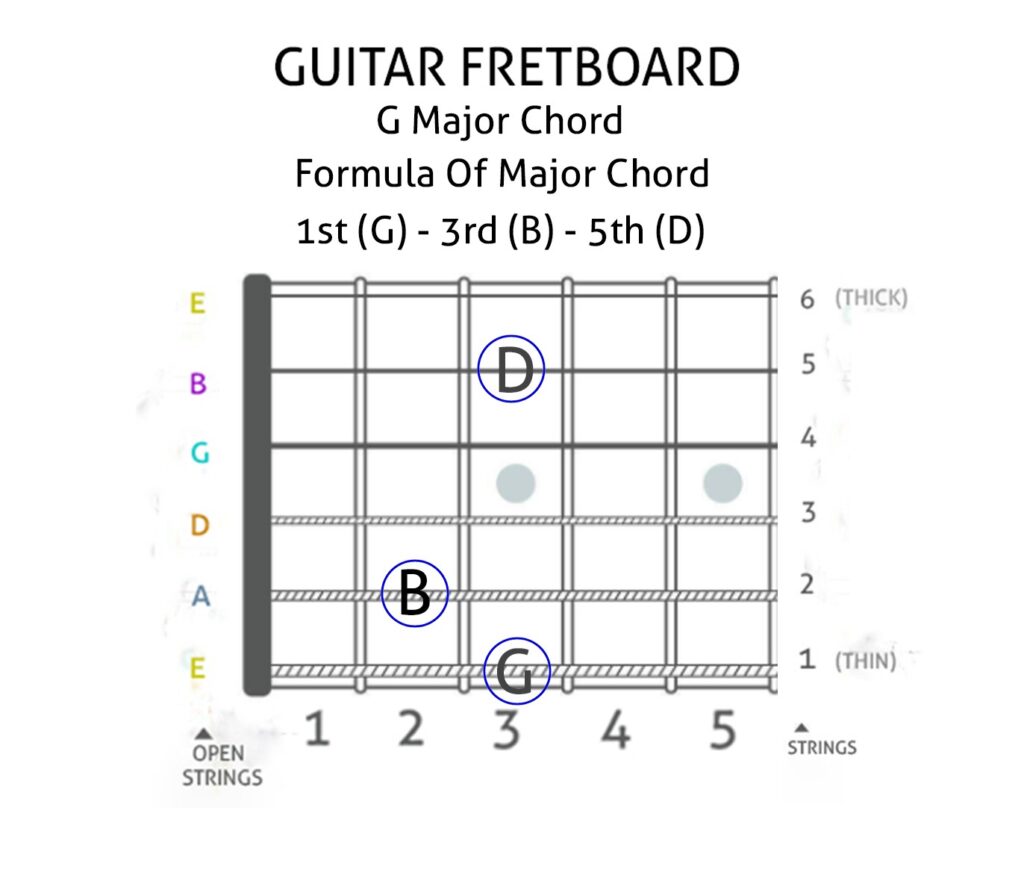
- Start with the 1st (G) the rote note
- Skip the 2nd note (A) and take the 3rd note (B)
- Skip the 4th note (C) and take the 5th note (D)
Put them all together G – B – D and you’ve built a G Major Chord.
- Note: G – B – D
- Formula: 1st – 3rd – 5th
| Chord Component | Scale Degree | Note |
| Root | 1st note | G |
| Major 3rd | 3rd note | B |
| Perfect 5th | 5th note | D |
Let’s Build The 7 Chord Formula Sheet: G Major Scale
| Degree | Chord | Notes | Chord Quality | Roman Numeral |
| 1st | G | G – B – D | Major | I |
| 2nd | Am | A – C – E | Minor | ii |
| 3rd | Bm | B – D – F# | Minor | iii |
| 4th | C | C – E – G | Major | IV |
| 5th | D | D – F# – A | Major | V |
| 6th | Em | E – G – B | Minor | vi |
| 7th | F#dim | F# – A – C | Diminished | Vii |
The Foundation Of G Major Key Chords Progression to Play:
In the key of G Major, the core harmonic engine is built on three functional notes. They give us the feeling of home, the experience of stepping away, and the powerful push to return back.
1. I – the home: G Major
2. IV – the journey: B Major
3. V – the tension: D Major
| Key | I (Home) | IV (Journey) | V (Tension) |
| G Major | G | B | D |
Unlocking The Harmonic Emotion in G Major Key:
Now let’s add the VI chord E minor in G Major chords progression. In the E minor VI chord functions as a tonic substitute. Emotionally, it brings vulnerability, warmth, and depth.
1. I – the home: G Major
2. VI – the soul: E Minor
3. IV – the journey: B Major
4. V – the tension: D Major
| Key | I (Home) | VI (The Soul) | IV (Journey) | V (Tension) |
| G Major | G | E minor | B | D |
Building the A Major Chord: Step By Step
You’ve already mastered The code in C Major, F Major, and G Major keys. Now it’s time to apply that knowledge to A Major key. Now we’re taking that exact same formula pattern 1- 3 – 5 to A Major. That never changes, no matter what key you’re in. A Major has one key distinction: it contains three sharps(F#, C#, and G#). These sharps give A Major its characteristically bright, resonant, and open sound that guitarists love more.
Here Is The A Major Scale:
A – B – C# – D – E – F# – G# – A
Let me show you how is works with the A Major chord:
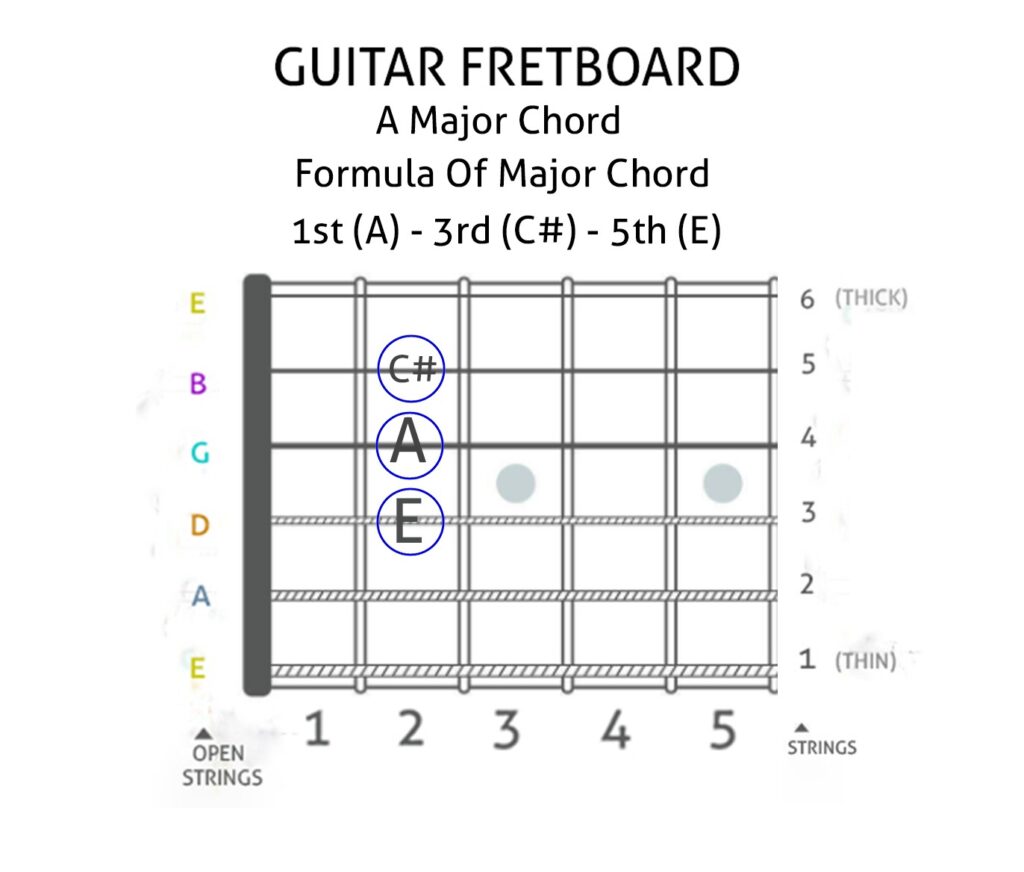
- Start with the 1st (A) the rote note
- Skip the 2nd note (B) and take the 3rd note (C#)
- Skip the 4th note (D) and take the 5th note (E)
Put them all together A – C# – E and you’ve built a A Major Chord.
- Note: A – C# – E
- Formula: 1st – 3rd – 5th
| Chord Component | Scale Degree | Note |
| Root | 1st note | A |
| Major 3rd | 3rd note | C# |
| Perfect 5th | 5th note | E |
Let’s Build The 7 Chord Formula Sheet: A Major Scale
| Degree | Chord | Notes | Chord Quality | Roman Numeral |
| 1st | A | A – C# – E | Major | I |
| 2nd | Bm | Bm – D – F# | Minor | ii |
| 3rd | C#m | C# – E – G# | Minor | iii |
| 4th | D | D – F# – A | Major | IV |
| 5th | E | E – G# – B | Major | V |
| 6th | F#m | F# – A – C# | Minor | vi |
| 7th | G#dim | G# – B – D | Diminished | Vii |
The Foundation Of A Major Key Chords Progression to Play:
In the key of A Major, the harmonic power comes from three foundational chords.They establish home,create movement away from it,and the strong pull back tension to resolution.
1. I – the home: A Major
2. IV – the journey: D Major
3. V – the tension: E Major
| Key | I (Home) | IV (Journey) | V (Tension) |
| A Major | A | D | E |
Unlocking The Harmonic Emotion in A Major Key:
Now add the VI chord F# minor into your A Major key progression. The VI F# a minor chord acts as a tonic substitute, offering a softer alternative to home. Emotionally, it brings warmth, vulnerability, and depth.
1. I – the home: A Major
2. VI – the soul: F# Minor
3. IV – the journey: D Major
4. V – the tension: E Major
| Key | I (Home) | VI (The Soul) | IV (Journey) | V (Tension) |
| A Major | A | F#minor | D | E |
The Final Pro Lesson: The Art of the Chord Journey
I spent weeks starting at diagrams, drilling every mode until I understood the Major key chords.The real difference between a beginner and a professional guitar player isn’t the number of chords they’ve memorized, it’s the ability to move between chords smoothly and purposefully. It’s how musically and smoothly they transition between them.
1. Use the Anchor Finger technique for Speed
The secret to fast chord changes aren’t about speed, it’s about moving it less. The real truth is minimizing unnecessary movement.
- How It Works: When switching from C Major “I” to A Minor “VI”. Notice that two fingers are already in position correctly or very close. Instead of lifting your whole hand off the fretboard! Keep those fingers anchored and only move the finger that absolutely needs to change position.
- What You Get: Your chord changes become clean, and silent no more awkward gaps or buzzing strings. No more dead air between chords or fumbling fingers. This is what makes transition sound professional and effortless.
2. Practice the Silent Transition Drill at 60 BPM.
Most guitar players make a critical mistake, they only practice chord changes only while strumming, which means they’re practising two things at once which divides their focus and slow their progress.
- How to Practice This: lock your metronome at 60 BPM. with each click, move your fretting hand between the progression I, VI, IV, V but don’t make any sound with your picking hand. No sound. Just finger movements.
- The Purpose: Removing the strumming forces our brain to dedicate 100% of its processing power to the physical mechanics of chord shapes and finger positioning. Once your fretting hand can execute these changes silently, and smoothly, adding rhythm becomes effortless. You’ve separated complex tasks into manageable pieces.
3. Think in Stories, Not Symbols: Storyboard for Every Progression.
To remember these patterns, stop thinking of them as abstract Roman Numerals and start experiencing them as emotional narratives.
- I (Home): Everything is peaceful and stable. The story begins.
- VI (The Soul): Things get emotional. The mood becomes more vulnerable.
- IV (Journey): The hero sets out from home. The energy starts to begin.
- V (Tension): Tension reaches its peak. You need to return home.
When you can hear and feel the story of each progression. You’re not memorising chord sequences, you’re living a musical story.
The Truth About Musical Foundation: FInal Word
No matter the genre is built on these fundamental patterns. Here’s what you need to remember: All music styles are constructed on these core patterns. Give them the respect they deserve, practice with patience and precision, and they will never ever let you f=down when you step on stage.