
The DNA Of Music: Mastering The Basic Major Scale
How Theory Changed My World: In the beginning I started playing guitar, I was completely obsessed with learning songs. As I explained in my beginner’s guitar,”From Zero To Riff: How To Start Playing The Guitar Today“ my focus was purely on copying what
I heard but I was always confused. Every time my teacher picked up the guitar before teaching me any new song, he would play a quick scale and then predict which chords were coming next. I couldn’t ignore it anymore. I asked him, how do you know those chords are there?.
That question changed everything, he told me to grab a notebook and start writing. He introduced me to the C Major scale. In that moment, my entire musical journey shifted to the next level from guessing to understanding. From that day my playing started becoming musical, advanced, and expressive.
What is the C Major Scale?: Clear and Educational
The C major scale is the simplest form of the major scale system because it contains no sharps (#) or flats (♭), and is represented on the piano by the white keys alone. This simplicity makes it the most straightforward and accessible scale to learn. For this reason, it serves as the foundation of western music theory.
Notes: C-D-E-F-G-A-B-C
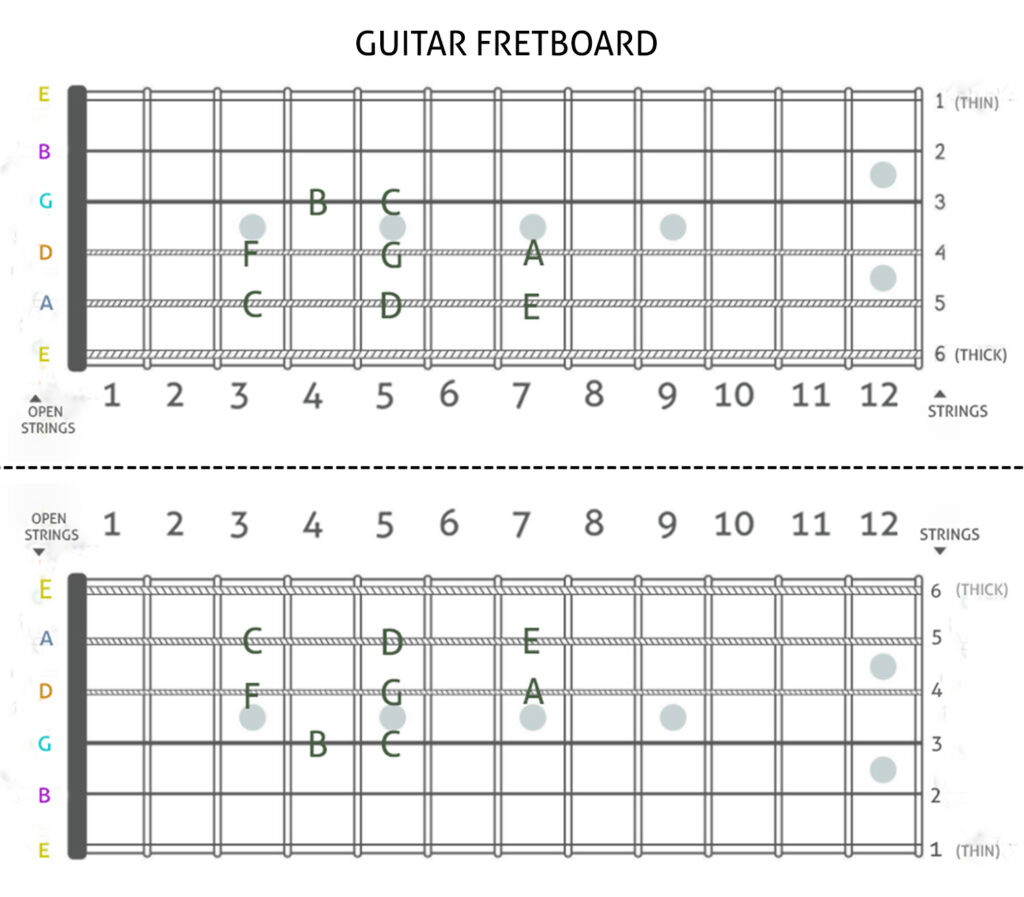
- Whole Step (W): Two frets forward, Skip one fret and move two frets ahead (1 → 3, 5 → 7).
- Half Step (H): A one fret interval between notes, move directly to the very next fret. (1→ 2,5 → 6).
The Formula That Unlocks Every Major Scale:
Every Major scale in music is created using the same formula.
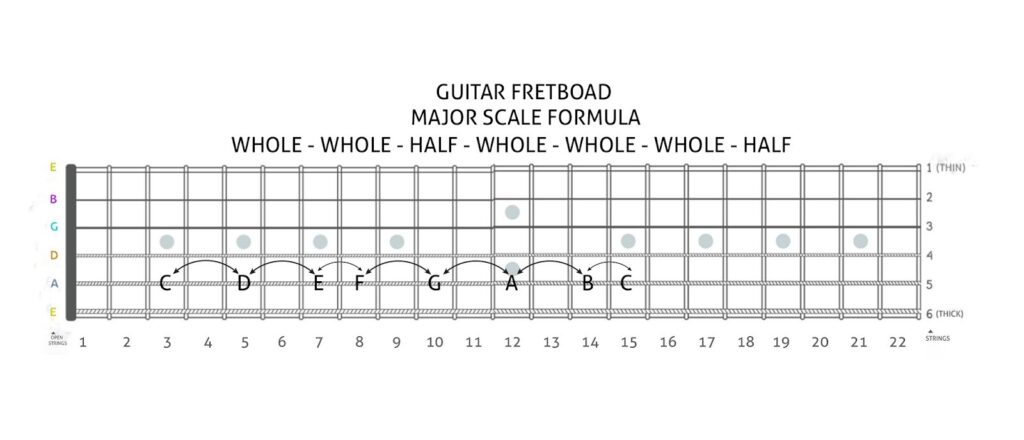
(W-W-H-W-W-W-H)
Formula Applied on C Major Scale: Step by Step Construction
| Start Note (From) | Step | Result Note (To) | Fret Distance |
| C | Whole Step (W) | D | 2 Frets |
| D | Whole Step (W) | E | 2 Frets |
| E | Half Step (H) | F | 1 Fret |
| F | Whole Step (W) | G | 2 Frets |
| G | Whole Step (W) | A | 2 Frets |
| A | Whole Step (W) | B | 2 Frets |
| B | Half Step (H) | C | 1 Fret |
Numeric Formula and Function: Scale Degrees
| Formula | Note | Interval | Degree Name |
| 1 | C | Unison | Tonic |
| 2 | D | Major Second | Supertonic |
| 3 | E | Major Third | Mediant |
| 4 | F | Perfect Fourth | Subdominant |
| 5 | G | Perfect Fifth | Dominant |
| 6 | A | Major Sixth | Submediant |
| 7 | B | Major Seventh | Leading Tone |
While the C Major scale is often called the “Mother Scale” due to its simplicity, many professional teachers often start students on with other scales like F Major or G Major or A Major. This is a great approach introduce you how to handle Sharps (#) and Flats (♭) early. Understanding how the same formula applies to a different key is what truly moves you from a “shape player” to a musician and master on fretboard.
Expanding Beyond:The F Major Scale
When moving from C Major to F Major, theory becomes more interesting and we encounter our first accident. To preserve the bright and balanced sound of the Major scale, the universal formula.
Universal Formula: (W – W – H – W – W – W – H)
Notes: F – G – A – B♭ – C – D – E – F
Why is the F Major scale important?: F Major proves that scales are built on formulas, it breaks the habit of relying only on natural notes not fixed notes. A natural B in this scale sounds wrong, but flattening it to (♭) restores the Major scale’s natural flow, harmonic identity, emotional clarity, sounding clean, resolved, and musically correct.
| Start Note (From) | Step | Result Note (To) | Fret Distance |
| F | Whole Step (W) | G | 2 Frets |
| G | Whole Step (W) | A | 2 Frets |
| A | Half Step (H) | B♭ (B-flat) | 1 Fret |
| B♭ | Whole Step (W) | C | 2 Frets |
| C | Whole Step (W) | D | 2 Frets |
| D | Whole Step (W) | E | 2 Frets |
| E | Half Step (H) | F | 1 Fret |
What Changes When You Move From C Major Scale to F Major:
- Why B♭ Exists (Adjustment): In C Major, half steps places naturally occur between E – F and B – C. In F Major, the same formula shifts the half step to A and B♭, introducing the note structure and teaching the scale awareness.
- New Finger Patterns (Adaptation): Practicing F Major forces your fingers into different finger spacing than C Major. This variation strengthens muscle memory and it develops control, flexibility, and the confidence needed for expressive lead playing.
Pro Tip from the Classroom: As my teacher taught me, don’t just memorize the B♭, learn to hear and feel the tension it creates. In any Major, scale the 4th degree B♭ in F Major create natural gravity that wants to resolve. When you are on stage playing a solo, knowing exactly where this flat note sits on the fretboard allows you to create that sweet and salty to intentionally pull the listener’s ear and shape a more expressive memorable solo on stage.
The Bright Side of Guitar:The G Major Scale
After Mastered F Major and its flat note, now it’s time to move into G Major. That key feels incredibly natural on the guitar. This is one of the most widely used keys in rock, pop, and folk guitar playing from acoustic guitar strumming to electric riffs.While F Major teaches you flats, G Major Marks an important milestone by introducing your first sharp (#), helping you balance both sides of the musical spectrum.
Universal Formula: (W – W – H – W – W – W – H)
Notes: ( G – A – B – C – D – E – F# – G)
Why The G Major Scale Matters On Guitar: G Major is essential because many iconic acoustic tracks and stadium filling rock songs live in the key of G Major. The presence of F# sits in the scale helps you to understand the leading tone that guides your ear smoothly back to the root note, G. Because it makes full use of several open strings, it delivers a wide, bright, ringing sound that feels effortless and inspiring on the guitar.
| Start Note (From) | Step | Result Note (To) | Fret Distance |
| G | Whole Step (W) | A | 2 Frets |
| A | Whole Step (W) | B | 2 Frets |
| B | Half Step (H) | C | 1 Fret |
| C | Whole Step (W) | D | 2 Frets |
| D | Whole Step (W) | E | 2 Frets |
| E | Whole Step (W) | F# | 2 Frets |
| F# | Half Step (H) | G | 1 Fret |
Why G Major Scale Sounds Complete and Open on Guitar:
- The F# Factor: In G Major, the scale demands a half step between its 7th and 8th notes. G Major requires an F# instead of a natural F. That subtle change creates tension that resolves perfectly into G, giving the scale its unmistakable finished feeling.
- Open Strings: One reason guitarists love G Major scale is because it allows you to use multiple open strings (G, D, B, and E). These open strings produce a wide, sound bigger, louder, and more resonant that feels powerful and alive than many other keys.
The Legendary Pro Tip: Secret Weapon
When soloing in G Major key, the F# carries the emotional weight. Sitting just one fret away from G, it naturally creates powerful tension. A slow bend or a deliberate resolution from F# to G produce a smooth, professional sound that instantly connects with the audience.
As the masters show us, legendary players don’t guess, they target emotions. Train your ear and fingers by practicing the G Major scale at 60 BPM until you can clearly visualize the F# across the entire fretboard.
Where Precision Meets Power: A Major Scale
The key of A Major scale follows the same universal formula, but the presence of three sharps forces your fingers into wider stretch and shifts across the fretboard in ways that C Major and G Major do not require.
Universal Formula: ( W – W – H – W – W – W – H)
Notes: (A – B – C# – D – E – F# – G# – A)
Why the A Major Scale Essential: A Major is one of the most commonly used keys in rock and metal for high energy stadium rock riffs and raid neoclassical passages. It is used in countless legendary tracks. It provides a clear, bright, powerful tone that makes fast runs and aggressive riffs sound precise and controlled, even at high tempos.
| Start Note (From) | Step | Result Note (To) | Fret Distance |
| A | Whole Step (W) | B | 2 Frets |
| B | Whole Step (W) | C# (C-sharp) | 2 Frets |
| C# | Half Step (H) | D | 1 Fret |
| D | Whole Step (W) | E | 2 Frets |
| E | Whole Step (W) | F# (F-sharp) | 2 Frets |
| F# | Whole Step (W) | G# (G-sharp) | 2 Frets |
| G# | Half Step (H) | A | 1 Fret |
Key Differences: Master in A Major Scale
The Three Sharp Challenge: A Major scale requires awareness of C#, F#, and G#. This pushes you into more structured fretboard patterns that helps to break reliance on open strings and strengthens your ability to navigate scale shapes across the neck.
The Bright Sound Explained: The distance between A and C# gives the scale its bright heart of A Major Scale. Hitting it with confidence over an A chord delivers that unmistakable legendary sweetness sound more musical and intentional.
The Legendary Pro Tip:
Every Major scale has a note that feels like gravity. Think of G# as your anchor note in A Major Scale. Because it sits only one fret below. It practically demands resolution. Try ending a rapid run by sliding from G# into a wide, confident A vibrato. Train this concept by practicing scale runs at 60 BPM. Once your fingers internalize the three sharp notes, your phrasing will sound intentional, controlled, and undeniably professional.
Why Is This the DNA?:
All chords and modes are the source of the Major scale. Master Major scale on the fret board, the guitar stops being a mystery, you’ll gain a clear roadmap to the entire fretboard, everything else is simply a variation of this foundation.
How to Turn Your Guitar Playing Into Real: Final Tips
Knowledge alone doesn’t create real musicians, consistent execution does. Don’t just scale up and down. Stay patient, stay disciplined, slow down, practice with a slow metronome, create small melodies, focus on clarity and practice daily even if only for 30 minutes. This disciplined approach is what turns theory into real musicianship.