A Complete Beginner’s Guide : Unlocking the Power of the Minor Scale
After mastering the C Major scale, I felt like I was discovering the foundation of music itself. But soon I realized something important: many of the songs I noticed carried a completely different mood: deep, intense, even painful sadness. I asked my teacher the question that changed everything: “what scale is that dark, how do I make my guitar sound like crying?”
He smiled and told me to grab my notebook. Then he added, You’ve mastered the mother scale. Now it’s time for her emotional twin: the natural minor scale. At that moment, I understood something powerful: Major scales build the structure of music but the minor scales shape the emotion.
From that point on, I finally started playing the kind of solos I always loved those sad, powerful melodies that truly speak. I realized I had always wanted a darker sound, but I couldn’t express it because I didn’t understand the scales and techniques behind it. Over time, as my understanding grew, I started expressing the music I had inside. That’s exactly why I’m sharing everything I know about music with you.
What Is The Minor Scale:
The Minor scale has its own hidden code of whole and half steps. Just like the Major scale. But with only a slight change in the pattern, the entire emotional feeling shifts from bright, happy to deep dark, sad and expressive.
Let’s start our minor scale journey with A Minor, the most common and easiest minor scale for beginners. It is the first minor scale many teachers recommend because it feels familiar and sits comfortably on the guitar. A minor is also special because it is the relative minor of C Major scale, the scale we explored in my earlier article, “The DNA Of Music: Mastering The Basic Major Scale” If you haven’t read it yet, it’s the perfect foundation before diving deeper into minor scales.
Note : A – B – C – D – E – F – G – A
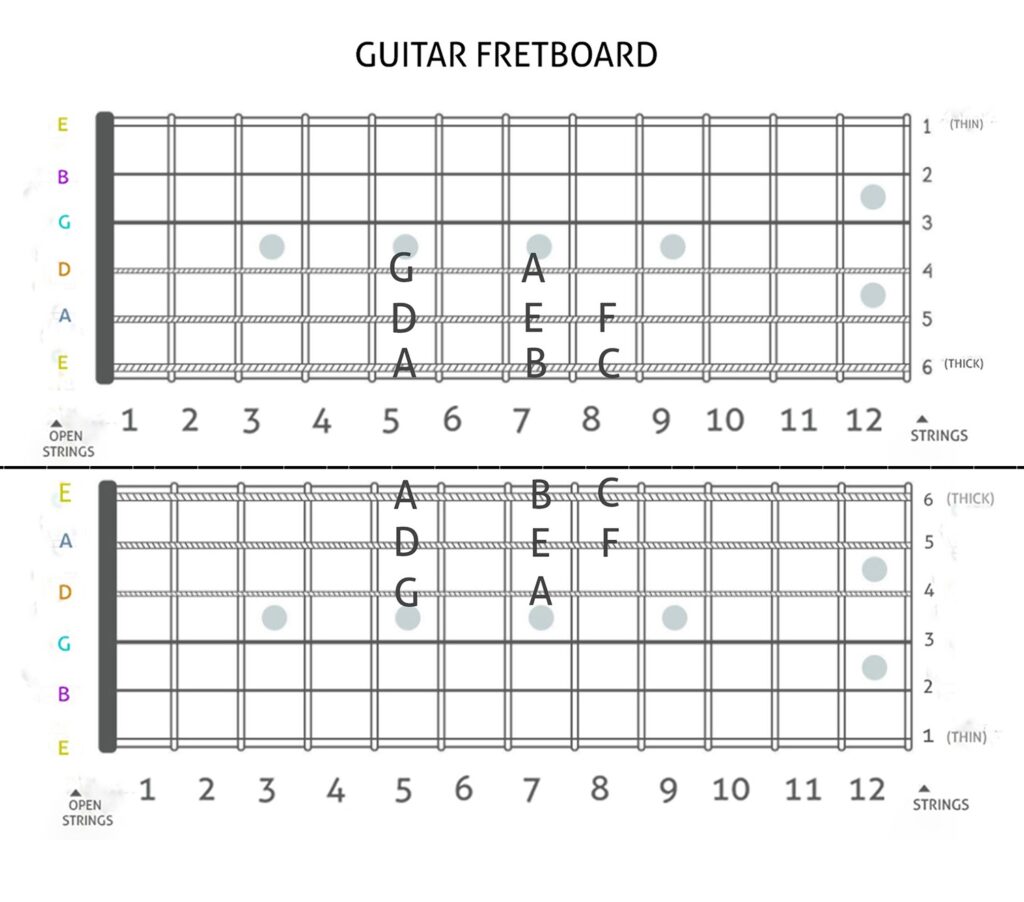
Formula : W – H – W – W – H – W – W
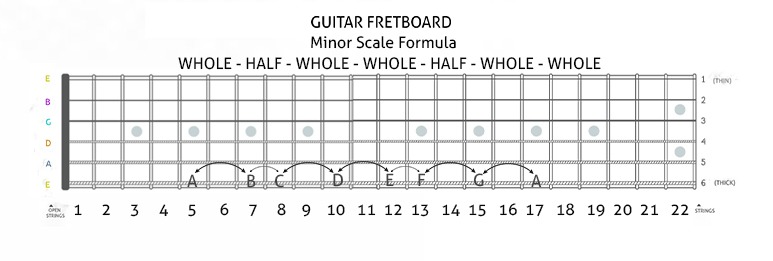
Formula Applied on A Minor Scale: Step by Step Construction
| Start Note (From) | Step | Result Note (To) | Fret Distance |
| A | Whole Step (W) | B | 2 Frets |
| B | Half Step (H) | C | 1 Fret |
| C | Whole Step (W) | D | 2 Frets |
| D | Whole Step (W) | E | 2 Frets |
| E | Half Step (H) | F | 1 Fret |
| F | Whole Step (W) | G | 2 Frets |
| G | Whole Step (W) | A | 2 Frets |
Numeric Formula and Function: Scale Degrees
| Formula | Note | Interval | Degree Name |
| 1 | A | Unison | Tonic |
| 2 | B | Major 2nd | Supertonic |
| ♭3 | C | Minor 3rd | Mediant |
| 4 | D | Perfect 4th | Subdominant |
| 5 | E | Perfect 5th | Dominant |
| ♭6 | F | Minor 6th | Submediant |
| ♭7 | G | Minor 7th | Subtonic |
Although a natural A Minor scale is the perfect starting point because it has no sharps or flats. It’s simple and beginner friendly. But real growth happens when you step into other minor keys and learn to handle accidentals confidently.
This is where the guitar stops being a set of shapes and becomes a musical language. When you can apply the same formula in any key, you begin to truly master the fretboard instead of simply memorizing patterns.
Expanding Beyond: The D Minor Scale
When moving from A minor scale to D minor Scale, theory becomes more interesting and this is where we meet our first accident. The minor scale formula stays the same, but the notes must change to preserve that balance.
Note : D – E – F – G – A – B♭/A# – C – D
Formula : W – H – W – W – H – W – W
Why D minor Is Important: D natural minor scale is relative to F Major scale, meaning they share the exact same notes but the mood completely changes. This is where theory becomes powerful: the scale isn’t about memorizing natural notes, it’s about respecting the formula. In D minor scale, the B♭/A# is essential.
A natural B would sound Bright and wrong, flattening it restores the scale’s true emotional weight draker, clean, and haunting. Understanding this relationship trains your ear to hear what belongs and what feels off. This is the sound of countless legendary sad solos.
| Start Note (From) | Step | Result Note (To) | Fret Distance |
| D | Whole (W) | E | 2 Frets |
| E | Half (H) | F | 1 Fret |
| F | Whole (W) | G | 2 Frets |
| G | Whole (W) | A | 2 Frets |
| A | Half (H) | B♭/A# | 1 Fret |
| B♭/A# | Whole (W) | C | 2 Frets |
| C | Whole (W) | D | 2 Frets |
What Changes When You Move From A Minor to D Minor Scale:
- B♭ Appears (Adjustment): In A minor Natural scale, the half steps occur naturally between B – C and E – F, SO you Don’t need any sharps or flats. But when you shift the same minor scale formula to D minor scale, the half step [placement forces one important change: B becomes B♭/A#. This Accidental is what preserves the true Dark DNA of the minor scale and teaches you that minor scale keys must follow the formula, not just the natural notes.
- Finger Patterns (Adaptation): Practicing D minor scale forces your hand into new spacing and shapes compared to A minor. Your fingers must adjust to the flat note and different fretboard position. This strengthens muscle memory, improves flexibility, and builds the control needed for smooth, expressive, and emotions; minor scale soloing.
Pro Tip; My Teacher’s Valuable Lesson: Understand the emotion behind every note. When I started learning the natural minor scale, I made the mistake which most beginners do, I treated it purely as a pattern to memorize. I could play the notes correctly, but something was missing. Then one day my teacher recognized this immediately and stopped me during practice.
This in to E minor
He Highlighted the Flat Note Minor 3rd, making clear this wasn’t just a technical modification, it was the emotional centerpiece of the minor sound.That single Flat note/Minor 3rd creates deep force, a melancholic pull that gives minor scales their distinctive darkness, emotional weight, and drama.
He shared something that stayed with me forever: the difference between a forgettable guitarist and a legendary one comes down to one thing: knowing which specific note will create an emotional reaction in the audience.
Once you deeply understand where that flat note / minor 3rd lives on your fretboard, your entire musical perspective will change. You graduated from playing mechanical scale patterns to crafting genuine musical stories. Solos that express genuine emotions, breathe, and resolve with that unforgettable quality that makes the minor scale so uniquely powerful.
The Dark Beauty of Guitar: E minor Scale
The E minor scale, after mastering D minor and flat note/minor 3rd, it’s time to explore E minor, a key that feels incredibly natural on the guitar. From rock anthems to folk ballads and pop hits, riffs, mostly E minor appears everywhere in the music.
What makes E minor unique compared to D minor scale and A minor scale is its absence of flat notes, E minor has no flats at all, making it unique among minor scales while still delivering that signature emotional powerful depth.
E minor scale is the relative minor scale of G major scale, they share the exact same notes, just starting from different positions on the scale.
Formula : W – H – W – W – H – W – W
Notes : E – F# – G – A – B – C – D – E
Why E Minor Scale is Important: E Minor scale utilizes all open six strings naturally, making it one of the easiest and most resonant minor scales on guitar. This naturally allows beginners to sound great immediately while giving advanced players maximum tonal richness. From “Stairway to Heaven” to “Smells Like Teen Spirit”, countless legendary songs are built on E minor scale.
While other minor scales require awkward fingering positions. Relationship with G Major scale unlocks music theory in practical, immediate ways. Once you understand this relative minor scale concept, you understand how all scales relate to each other. The low E string provides bass heavy power that cuts through any mix. This gives solos and riffs an authoritative quality that other keys simply can’t match.
| Start Note (From) | Step | Result Note (To) | Fret Distance |
| E | Whole (W) | F# | 2 Frets |
| F# | Half (H) | G | 1 Fret |
| G | Whole (W) | A | 2 Frets |
| A | Whole (W) | B | 2 Frets |
| B | Half (H) | C | 1 Fret |
| C | Whole (W) | D | 2 Frets |
| D | Whole (W) | E | 2 Frets |
What Changes When You Move From D Minor to E Minor Scale:
- No Flats Required: In D Minor scale you learn that B Becomes B♭/A# to preserve the minor scale formula (the flat note/minor 3rd) creates the characteristic dark emotional tension. But when you transition to E Minor scale using the same minor scale formula something important changes, all the notes fall naturally without requiring any flats. The half steps naturally fall between F# – G and B- C, making the E minor scale one of the purest, most beautiful and most natural minor scales on guitar.
- Finger Patterns: Moving from D Minor scale to E Minor scale requires adapting your finger patterns to new fretboard positions. You’ll use different string combinations.This transition develops finger independence, expands your fretboard vision, and enhances the control necessary for emotionally powerful minor scales playing across multiple keys.
Pro Tip; Power,Speed, and Perfect Practice: From my own personal experience, E Minor scale is unbeatable for rock guitar. The open low E string give me a massive, crushing, heavy foundation for riffs. That open note resonates with power and depth that other keys simply can’t match. It’s the secret behind countless iconic rock riffs.
Beyond the heavy sound, E minor scale has transformed my shredding ability. E minor scale offers more comfortable positions across the fretboard than any other scale, making it ideal building speed and practicing fast runs. No matter which technique you’re developing alternate picking, legato, or any other advanced techniques. E minor provides you the easiest, most efficient practice platform.
The comfortable fingerings mean you’re a;ways working on the right technique itself. Want to dive deeper into these techniques? Check out my earlier article. “Stop Wasting Time: The Right Techniques To Learn Guitar Faster.” Where I break down exactly how to practice and master each technique step by step.
Sharp Edge Of Emotion: F# Minor Scale
After Learning Minor Scales Like A Minor and D Minor, the next step os F# Minor scale. A key that feels sharper, tighter, and more intense. The most powerful minor key used in today’s legendary guitar music from emotional ballads to aggressive stadium solos. It is not just a scale, it is a weapon for expression when you want to sound serious, deep, and professional.
Formula : W – H – W – W – H – W – W
Notes : F# – G# – A – B – C# – D – E – F#
Why F# Minor is Important: F# Minor is important because it forces your fingers to handle accidentals naturally. Its sharp, focused sound allows solos to feel emotional but still powerful. F# minor key trains real fretboard discipline, stretching your hand into stronger shapes and building the precision needed for fast legendary runs and expressive solos.
| Start Note (From) | Step | Result Note (To) | Fret Distance |
| F# | Whole (W) | G# | 2 Frets |
| G# | Half (H) | A | 1 Fret |
| A | Whole (W) | B | 2 Frets |
| B | Whole (W) | C# | 2 Frets |
| C# | Half (H) | D | 1 Fret |
| D | Whole (W) | E | 2 Frets |
| E | Whole (W) | F# | 2 Frets |
What Changes When You Move From E Minor Scale To F# Minor Scale:
- More Sharps, More Cinematic: E minor is open, raw and classic. But F# minor is modern, dramatic and introduces more accidentals. It is the key to soaring and forcing cleaner technique and stronger fretboard awareness.
- The Leading Tone Power With More Tension, More Expression: F# Minor scale creates stronger pull notes because the sharps sit closer to resolution points. F# Minor has an emotional edge, making it perfect for powerful modern solos and melodic runs.
Why Minor Keys Are Important to Learn:
Minor scales are where music becomes human and one of the most important tools in modern guitar music. Major scales build brightness, and minor scales build for depth. Most rock solos, cinematic melodies, and emotional riffs are written in minor keys. If you want your guitar to sound like it’s speaking, crying, or screaming the minor scale is the path. Once you understand minor scale formu;as, you stop playing on guitar random notes and start playing with purpose, mood, and control.
Final Tips; How to Turn Your Guitar Playing Into Real Music:
Practice minor scales slowly with a 60 or 80 BPM/metronome, focus on sound and notes not speed. Don’t rush, play it like a story, not drill. Train your ear to feel the tension, expressions, and release inside the notes. Scales are not just exercises, once you can hear the emotion, your solos will stop sounding like practice and start sounding like real music, they are the vocabulary of your music voice.
For me, the minor scale truly came alive through E minor, because it gave me the sound I always wanted and endless freedom. I could strike the open low E string and let that deep bass note ring in the background then play melodies on top, feeling the power, and depth of the scale in a real way.
I discovered how naturally I could shift E natural minor into E minor Pentatonic, then into E harmonic Minor, and back again. That is when I understood that scales are not just patterns, they are emotions. So practice slowly, stay consistent, and learn to express something real. That is how legends are built.