The 7 Colors Of Music: Mastering the Major Mode System
Most guitarists spend years inside the Major boxes. C Major sounds balanced classic bright. But how do legend players like Faraz Anwar or Joe Satriani achieve unique textures, epic, mystical, cinematic, or even Spanish?
They’re not using different notes. They’re using Modes and that’s when I learned the real power.
If you want a deeper understanding of how the Major scale world and why it sounds this way, I’ve explained it thoroughly in my previous article “The DNA Of Music: Mastering The Basic Major Scale”.
When I first started learning the Major mode system, it completely changed my perspective on the guitar. It opened my eyes to many new shapes and scale patterns. Before that, I was stuck playing the same Major scale positions over and over, and it never gave me the freedom to move across the entire neck of the guitar.
I used to write all the notes in my notebook first, and then apply them on the fretboard. That process helped me to discover new positions and positions that made my fingers move in ways they never had before. It improved my flexibility and allowed me to practice new techniques naturally.
After learning modes, I finally began to hear a different level of my sound in my solos, and made it much easier to recognize chords and understand how songs are built.
What is Major Mode?
The C Major Scale:
C – D – E – F – G – A – B – C
A mode uses the exact same notes, but shifts the tonal center. Instead of treating the C note as home, you chose another note: the root.
When C functions as the tonic, you hear Ionian “Major”. When starting on D and suddenly the same note feels darker and more serious, the identical notes produce Dorian, a completely different emotional quality.
Change the root, change the mood. You don’t rewrite the script, You just change who the story revolves around.
| Order | Mode Name | Starting Note (in C) | Chords / Scales | The Vibe / Mood | Legendary Example |
| 1st | C | Ionian | Major | Happy, Pure, Bright | Pop music & Anthems |
| 2nd | D | Dorian | Minor | Soulful, Jazzy, Cool | Carlos Santana/ Blues Rock |
| 3rd | E | Phrygian | Minor | Exotic, Spanish, Dark | Heavy Metal & Flamenco |
| 4th | F | Lydian | Major | Spacey, Dreamy, Heroic, Epic | Sci-Fi Soundtracks |
| 5th | G | Mixolydian | Major | Bluesy, Rock & Roll, Raw | AC – DC / Jimi Hendrix |
| 6th | A | Aeolian | Minor | Emotional, Sad, Heavy | Natural Rock Ballads |
| 7th | B | Locrian | Diminished | Unstable, Tense, Dark | Extreme Metal / Diminished Jazz |
Before we go further, remember this, you have already mastered the C Major scale, also known as the Ionian mode. You can review its formula and full breakdown in my earlier article “What is the C Major Scale?: Clear and Educational”.
The D Dorian Scale/Mode:
Here’s the exciting part: the moment you learned C major, you also learned D Dorian.
D Dorian is built by taking C Major scale / Ionian and redefining D as the tonal center. It starts on D and ends on D, but it uses the same white key notes. Even though the note pool doesn’t change, the sound completely shifts. The result is a minor sounding scale with raised 6th degree. It feels like a minor scale, but not as dark as a natural minor scale. It has a cool, bright,jazzy sound that makes it perfect for fusion solos and blues rock. This is why many blues and jazz guitar players favor it for expressive soloing.
Dorian is a minor mode due to its flat 3rd degree, but its personality is unique. Natural minor tends to sound deeply emotional or melancholic heavy, where dorian feels mother, cooler, more soulful, and slightly brighter.
- Notes: D – E – F – G – A – B – C – D
- Formula: W – H – W – W – W- H – W
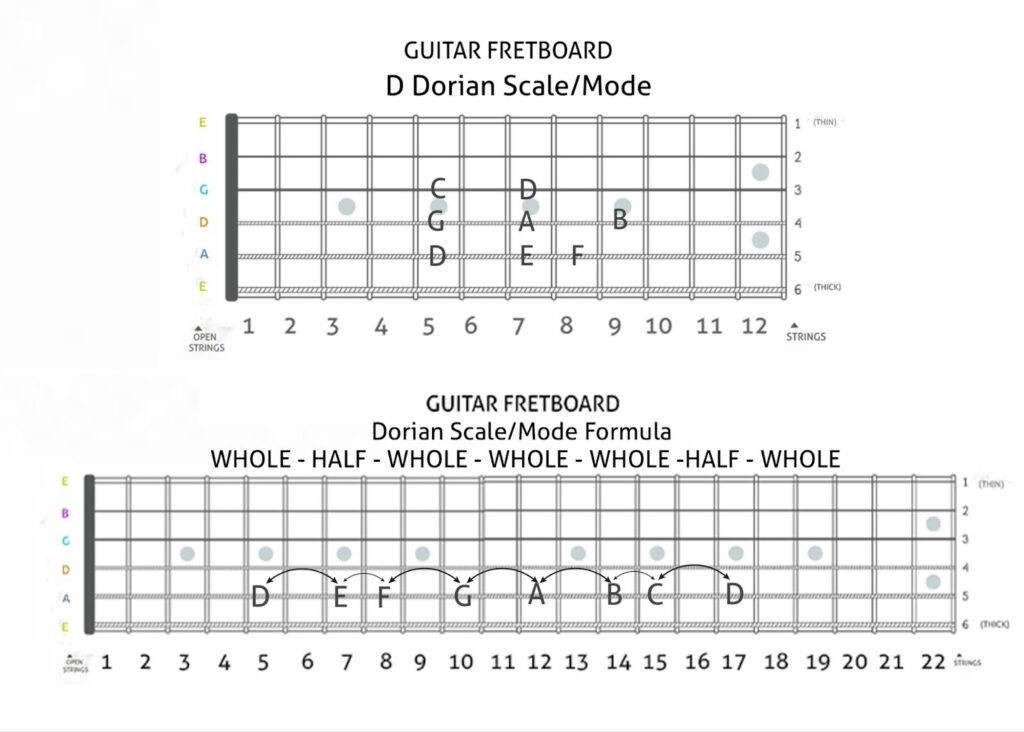
| Start Note (From) | Step | Result Note (To) | Why is it “Dorian”? |
| D | Whole Step (W) | E | The 2nd note of C Major. |
| E | Half Step (H) | F | The ♭3 (Minor 3rd) This makes it sound Minor. |
| F | Whole Step (W) | G | The 4th note. (Perfect 4th) |
| G | Whole Step (W) | A | The 5th note. (perfect 5th) |
| A | Whole Step (W) | B | The Natural 6th. This is the Magic Note. |
| B | Half Step (H) | C | The ♭7 note. |
| C | Whole Step (W) | D | Home (Octave). |
The Difference: The Natural Minor 6th:
If you compare the D Dorian scale to D Natural Minor scale, there is only one note separating D Dorian from D Natural Minor scale.
That is the single change, B♭ to B natural to transform the entire mood.
In natural Minor scale the B♭ adds a heavier, darker, deep, and melancholic sound. In Dorian scale, the Natural B creates a lighter, jazzy, smoother sound.
- D Natural Minor Notes: D- E – F – G – A – B♭ – C – D
- D Dorian Notes: D – E – F – G – A – B – C – D
The E Phrygian Scale/Mode: Dark and Dangerous Mode
E Phrygian is the 3rd mode of the C Major scale. Starting on E but using the same white key notes. What makes it special? It is considered a minor mode due to its flat 3rd (G). However, its defining characteristic is the flat 2nd (F). That half step movement creates instant tension. On guitar, this is incredibly powerful, especially when you emphasize that flat 2nd in riffs or solos. It’s the sound of Flamenco fire and heavy metal, aggressive darkness, exotic, mysterious, tense, and powerful.
- Notes: E – F – G – A – B – C – D – E
- Formula: H – W – W – W – H – W – W
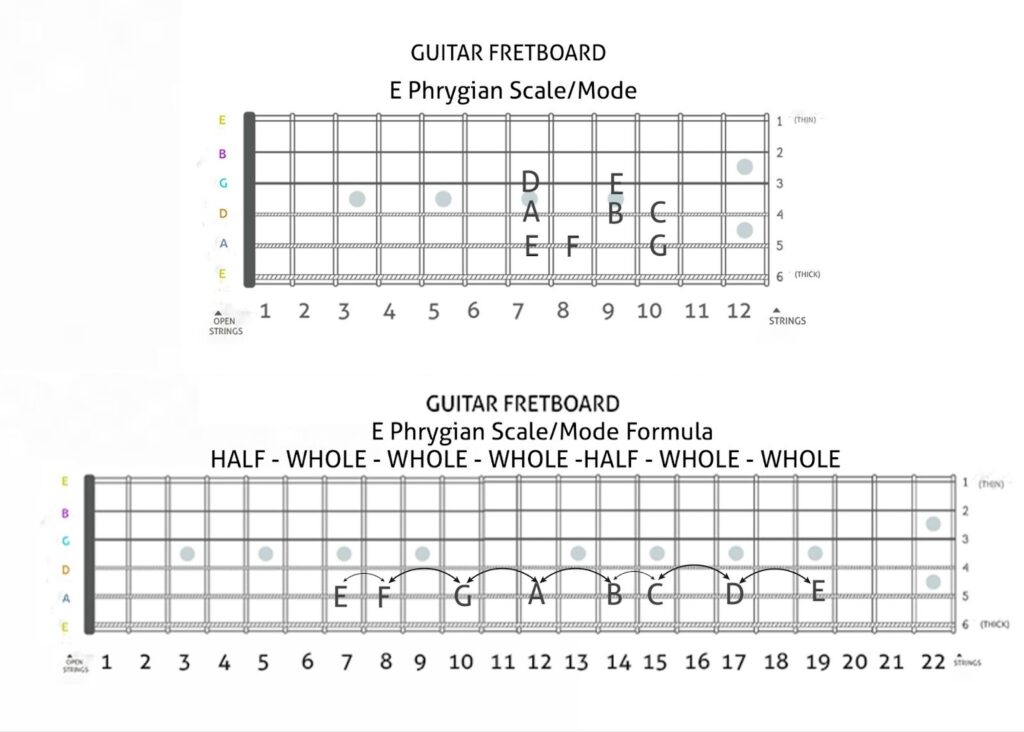
| Start Note (From) | Step | Result Note (To) | Why is it “Phrygian”? |
| E | Half Step (H) | F | The ♭2 (Minor 2nd). The defining dark note. |
| F | Whole Step (W) | G | The ♭3 (Minor 3rd). Confirms minor mode. |
| G | Whole STep (W) | A | The 4th note (Perfect 4th). |
| A | Whole Step (W) | B | The 5th note (Perfect 5th). |
| B | Half Step (H) | C | The ♭6 note. Adds exotic color. |
| C | Whole Step (W) | D | The ♭7 note. Classic minor tension. |
| D | Whole Step (W) | E | Home (Octave). |
The Difference: The Minor 2nd(♭2)
E Phrygian and E Natural Minor scales are almost similar, except for one note.
E Phrygian: E Phrygian replace that F# with F natural. That half step between E and F. On guitar when you move from the open E string to the first 1st fret F, you immediately hear the Spanish style, darker sound.
- Notes: E – F – G – A – B – C – D – E
- Formula: H – W – W – W – H – W – W
E Natural Minor: E Natural Minor scale uses F#, which gives the scale space. It feels emotional and familiar.
- Notes: E – F# – G – A – B – C – D – E
- Formula: W – H – W – W – H – W – W
The F Lydian Scale/Mode:
F Lydian is the 4th mode of the C Major scale, built from the notes. It begins on F but uses the same notes.
Lydian is a technically major mode, but it doesn’t sound like a standard major scale. Instead of simply happiness, Lydian feels bright, expansive, uplifting, heroic, and something rising into the sky.
The magic of sound comes from the rise of 4th (B). That interval creates a wider tonal space at the beginning of the scale, creating tension, floating, and ethereal character. It’s the sound of progressive rock, cinematic leads, and soaring melodies.
- Notes: F – G – A – B – C – D – E – F
- Formula: W – W – W – H – W – W – H
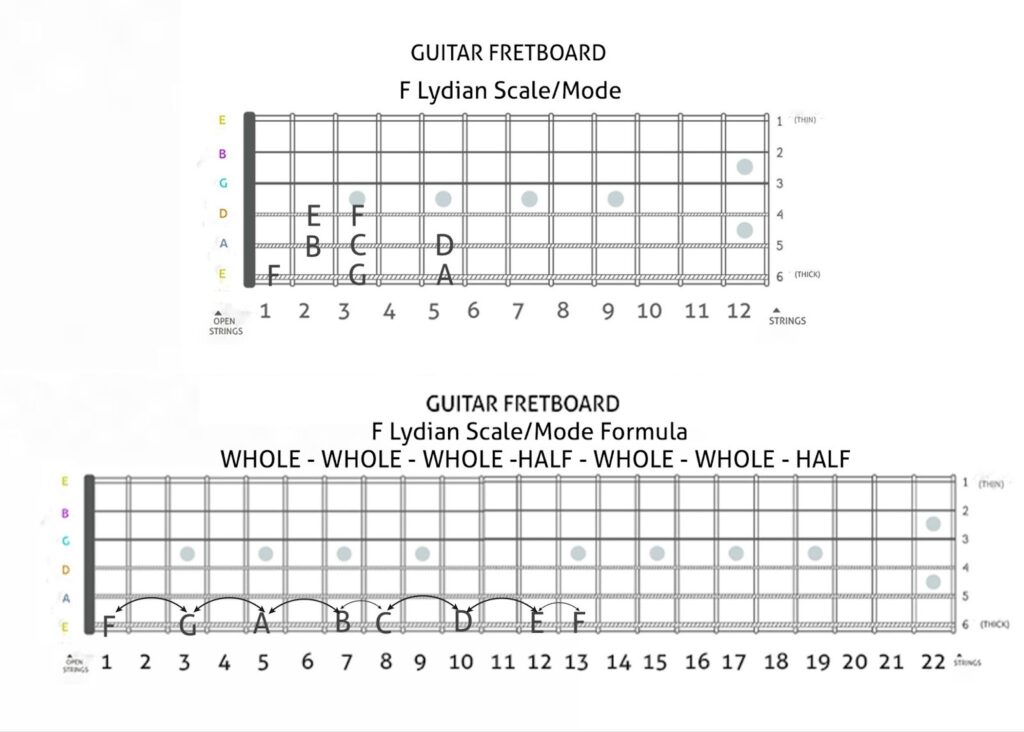
| Start Note (From) | Step | Result Note (To) | Why is it “Lydian”? |
| F | Whole Step (W) | G | The Major 2nd note. |
| G | Whole Step (W) | A | The Major 3rd (sounds happy). |
| A | Whole Step (W) | B | The #4 (Sharp 4th), The Spacey note. |
| B | Half Step (H) | C | The 5th note (Perfect 5th), Stability Point. |
| C | Whole Step (W) | D | The Major 6th note. |
| D | Whole Step (W) | E | The Major 7th note, Bright Leading Tone. |
| E | Half Step (H) | F | Home (Octave). |
The Difference: The 4th Degree
F Natural Major: In F Natural Major scale, B♭ 4th note creates a grounded and traditional major sound.
- Notes: F – G – A – B♭ – C – D – E – F
- Formula: W – W – H – W – W – W – H
F Lydian: In the F Lydian scale, B 4th note naturally forms an augmented interval against F, producing upward tension and brightness.
- Notes: F – G – A – B – C – D – E – F
- Formula: W – W – W – H – W – W – H
The G Mixolydian Scale/Mode:
G Mixolydian scale is the 5th mode of the C Major scale. It’s technically a major mode because it contains a major 3rd B note. However, the secret is the ♭7 F natural. The 7th degree. That one note removes the sweet, storybook ending of the major scale and replaces it with swagger. That’s why mixolydian feels bluesy but happy. It’s the heartbeat of rock riffs, classic blues solos, and stadium choruses.
- Notes: G – A – B – C – D – E – F – G
- Formula: W – W – H – W – W – H – W
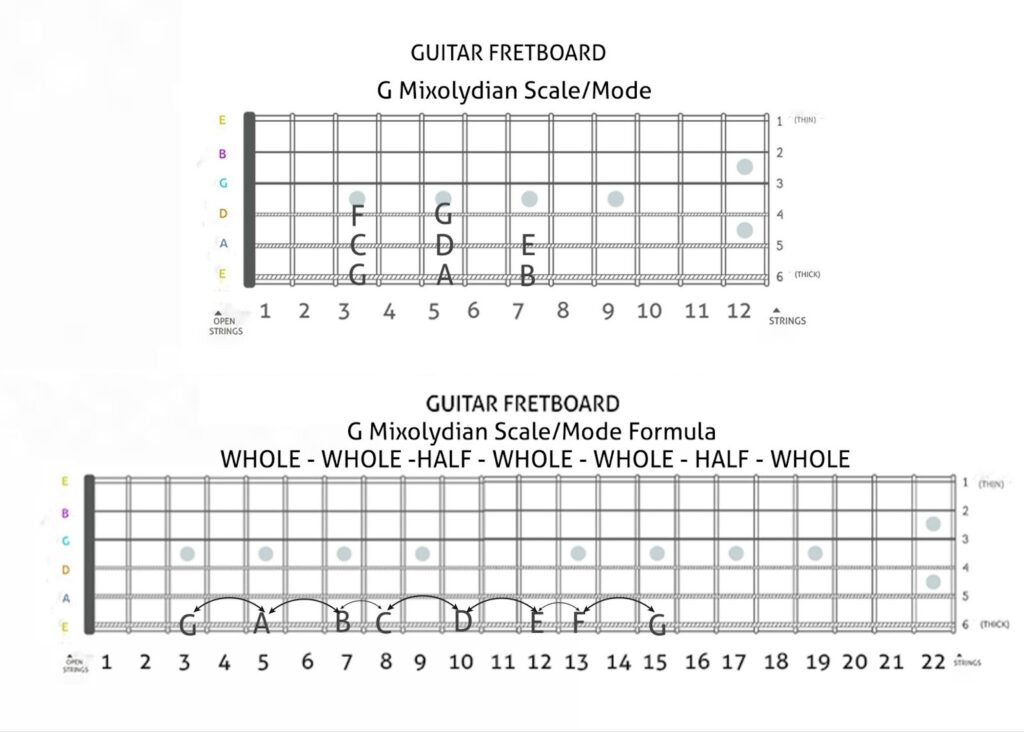
| Start Note (From) | Step | Result Note (To) | Why is it “Mixolydian”? |
| G | Whole Step (W) | A | The Major 2nd note. |
| A | Whole Step (W) | B | The Major 3rd (keeps it happy). |
| B | Half Step (H) | C | The Perfect 4th note. |
| C | Whole Step (W) | D | The Perfect 5th note, Strong Foundation. |
| D | Whole Step (W) | E | The Major 6th note. |
| E | Half Step (H) | F | The ♭7 (Minor 7th), The Bluesy note. |
| F | Whole Step (W) | G | Home (Octave). |
The Difference: The Flat 7th Degree (♭7)
G Major vs G Mixolydian
G Mixolydian: G Mixolydian feels more open and gritty. In this scale F natural softens that tension and creates a blues based feel, more relaxed, and a rock and roll attitude.
- Notes: G – A – B – C – D – E – F – G
- Formula: W – W – H – W – W – H – W
G Natural Major: G Major feels polished, complete and bright. In G Natural Major scale F# acts as a strong resolution leading tone that wants to resolve back to G note.
- Notes: G – A – B – C – D – E – F# – G
- Formula: W – W – H – W – W – W – H
The A Aeolian Scale/Mode: (Natural Minor)
Welcome to the most important mode you’ll learn, A Aeolian, the 6th mode of C major scale. Most players recognize this as a Natural Minor Scale, but viewing it as a mode unlocks something powerful. This understanding enables you to transition between Major and Minor sounds without shifting hand positions.
Aeolian serves as the dark mirror of the Majoor scale. But beginning on A, The resulting intervals produce a sound that’s contemplative, and versatile for both aggressive riffs and rock emotional ballads.
- Notes: A – B – C – D – E – F – G – A
- Formula: W – H – W – W – H – W – W
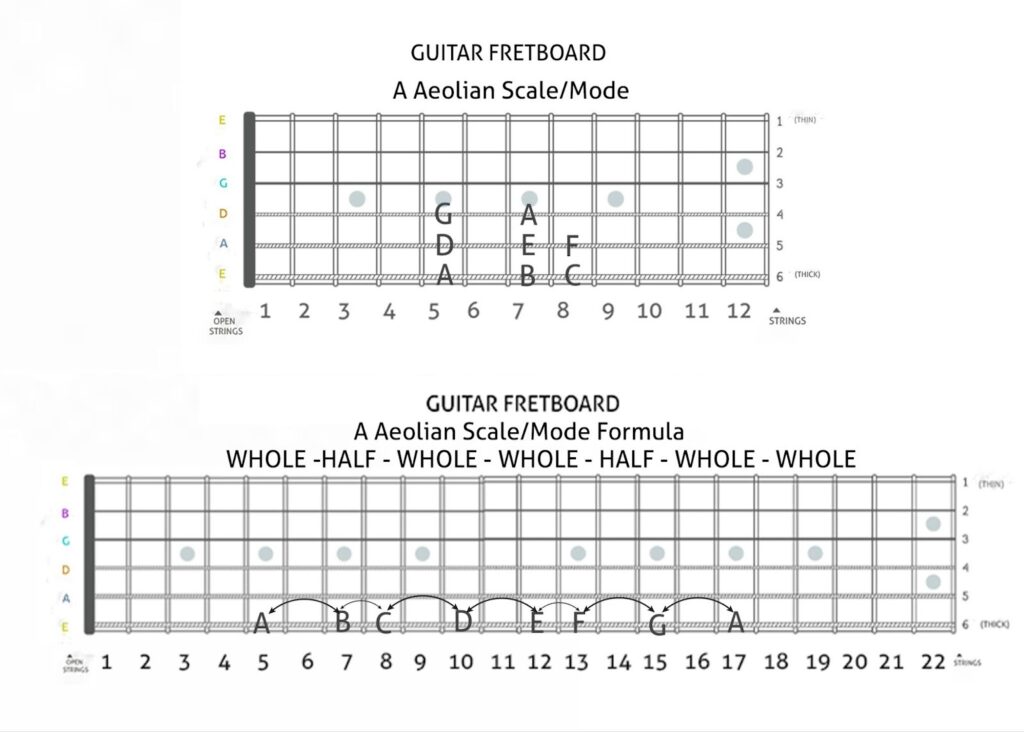
| Start Note (From) | Step | Result Note (To) | Why is it “Aeolian”? |
| A | Whole Step (W) | B | The 2nd Major note. |
| B | Half Step (H) | C | The ♭3 (Minor 3rd),The Sad note. |
| C | Whole Step (W) | D | The Perfect 4th note. |
| D | Whole Step (W) | E | The 5th note (Perfect 5th), Stable Anchor. |
| E | Half Step (H) | F | The ♭6 (Minor 6th), The Dark Note. |
| F | Whole Step (W) | G | The ♭7 (Minor 7th), Classic Minor Tension. |
| G | Whole Step (W) | A | Home (Octave). |
The Relative Key Connection: C Major and A Aeolian
This is the game changing concept that transforms your understanding of music. C Major scale and A Aeolian “A Minor” are relative keys, meaning they’re built from the same notes.
- C Major
Notes: C – D – E – F – G – A – B – C
Formula: W -W – H – W – W – W – H
- A Aeolian
Notes: A – B – C – D – E – F – G – A
Formula: W – H – W – W – H – W – W
Look Closely, same seven notes, different starting points. This means every scale pattern, chord shapes, and lick you know in A minor works in C Major scale. This is the secret weapon that makes experienced guitarists seem psychic, they recognize that relative keys give you complete fretboard access with half the memorization.
Want to explore minor scales in depth? Check out my detailed article “A Complete Beginner’s Guide : Unlocking the Power of the Minor Scale”
Entering the Darkest Mode: B Locrian
We’ve reached the outer edge of the modal system: B Locrian, the 7th note and final mode of C Major scale. This is the most challenging and uniquely unstable Mode because it naturally resists resolution, it sounds intentionally unfinished and unsettled. Classical composers traditionally avoided it, but in dark jazz fusion, heavy metal, and film scores Locrian has become an essential tool for creating maximum tension and unease.
It doesn’t just sound dark like Phrygian, it sounds unresolved like an unsolved mystery or nightmare that refuses to end. The source of Locrian’s unique instability is the flattened 5th interval note ♭5. Every other mode the perfect 5th note provides harmonic stability and grounding. Locrian eliminates that anchor entirely, leaving the mode floating without resolution, constantly seeking stability it can never find.
- Notes: B – C – D – E – F – G – A – B
- Formula: H – W – W – H – W – W – W
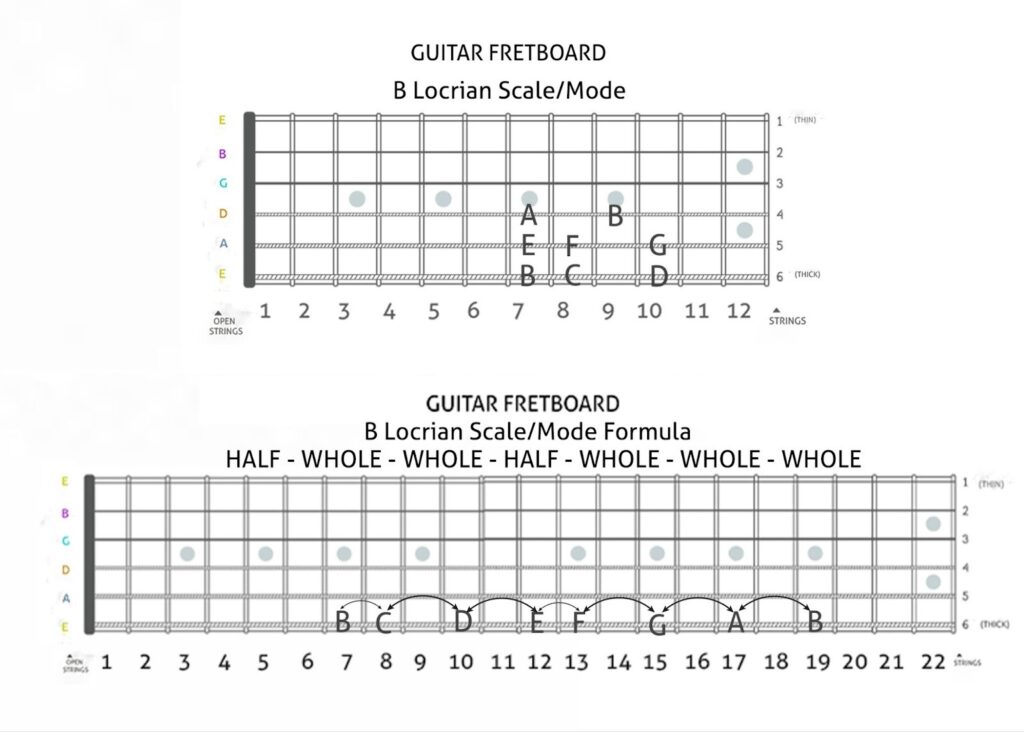
| Start Note (From) | Step | Result Note (To) | Why is it “Locrian”? |
| B | Half Step (H) | C | The ♭2 (Minor 2nd), Immediate tension. |
| C | Whole Step (W) | D | The ♭3 (Minor 3rd), Keep it minor. |
| D | Whole Step (W) | E | The Perfect 4th note. |
| E | Half Step (H) | F | The ♭5 (Diminished 5th), The Devil’s Interval! |
| F | Whole Step (W) | G | The ♭6 note (Minor 6th). |
| G | Whole Step (W) | A | The ♭7 note (Minor 7th). |
| A | Whole Step (W) | B | Home (Octave). |
The Devil’s Difference: B Locrian ♭5
The distance between the B and F note is known as a tritone. Medieval music theorists literally named this “Diabolus in Musica” the Devil in Music.
Locrian 5th note is flattened so you cannot build a standard power chord “1 – 5” in this mode. You must use Diminished chords “1 – ♭5” producing that characteristic cold that defines extreme metal riffs, dark cinematic moments, and horror film scores. This interval doesn’t resolve naturally, it demands movement, creating perpetual tension.
- B Major
Notes: B – C# – D# – E – F# -G# – A# – B
Formula: W- W – H – W – W – W – H
- B Locrian
Notes: B – C – D – E – F – G – A -B
Formula: H – W – W – H – W – W – W
Why Everyone Rushed: Stop Playing Fast Before You Can Play Right
The number one mistake I see students make and honestly I made it too, is trying to play a new mode at full speed. Sure, your fingers might be moving but your bain isn’t actually learning anything. It’s not recording anything, but you’re not absorbing the musical DNA.
Set your metronome to 60 BPM. If you’re already comfortable with the fingering, maybe push it to 80 BPM. At these slower tempos “Metronome”, you actually have time to hear what makes modes sound “Heroic”, or “Dark”. You’re not just running through notes, you;re listening and internalizing.
Why does this matter? Because 60 BPM is where real muscle memory builds genuine memory.
Here’s how I finally got all seven modes:
Use the 3 notes per string system. Stop thinking about 7 seven different scales, that’s how it works. Think of the fretboard as one continuous highway. The shape of the scale stays identical, you’re just choosing different starting positions.
Star on the 1st note “That’s Ionian”. Move your starting point down to the 2nd note, but keep using the 3 note per string pattern? Now you’re playing Dorian. When you see modes as starting points on one unified map rather than seven disconnected scales, everything becomes way clearer.
Don’t try to master all seven modes in one hour.
- Monday: C Ionian.
- Tuesday: D Dorian.
- Wednesday: E Phrygian
- Thursday: F Lydian
- Friday: G Mixolydian
- Saturday: A Aeolian
- Sunday: B Locrian
Spend 20 or 30 minutes at 60 BPM just going up and down.
The Pro Tip:
I totally understand. Staring at seven different modes can feel overwhelming like you’re standing at the base of a mountain wondering if you’ll ever reach the top. You see virtuosos flying through these scales at ridiculous speeds and your brain tells you I need to get fast if I want to be good.
But let me share the game changing secret: the truth that changed everything for me. The same lesson my teacher drilled in my thick skull and the same advice you’ll hear from the famous legends. If you genuinely want to play fast, you need to practice slowly. That feels almost painful and boring but that is the real key.